Nakasu:
visit every night, book with open eyes.
A sandbar island of neon between the two downtowns: the famous yatai row on the river side, hostess clubs and a working red-light quarter on the eastern blocks. Both facts belong in your booking decision.
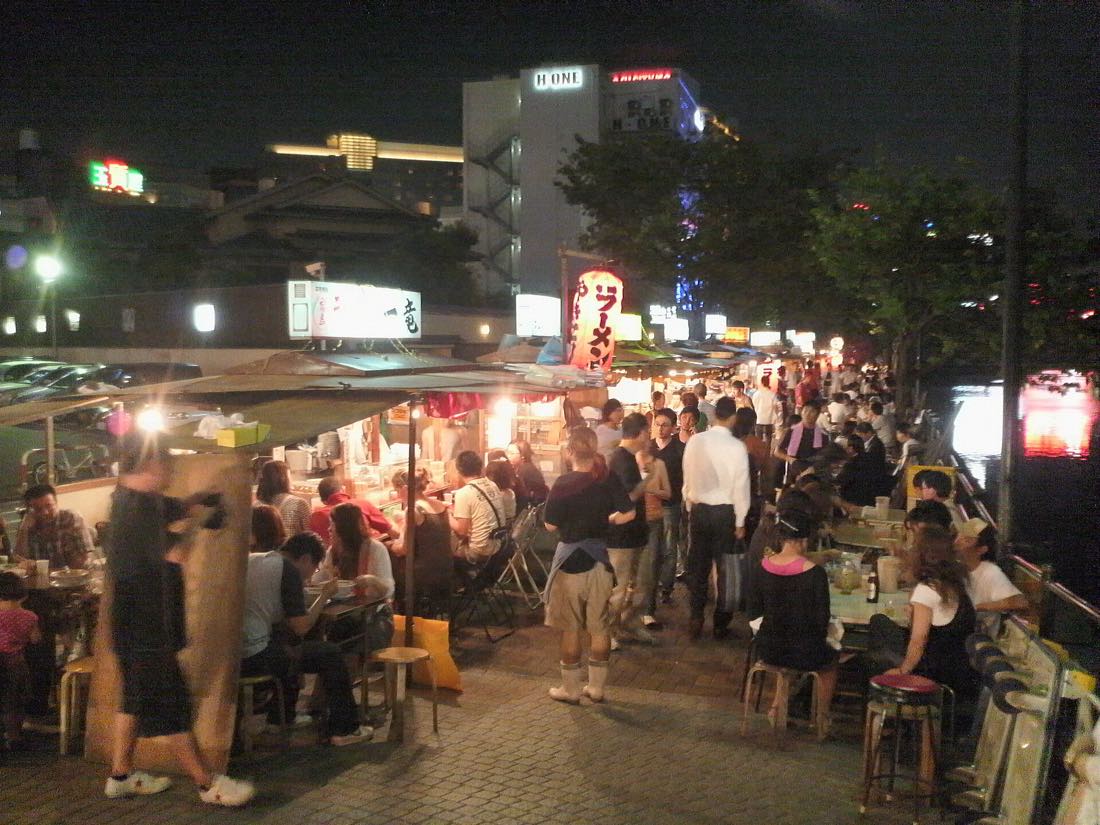
Nakasu is a river island roughly 250 by 1,500 metres holding the densest concentration of nightlife in Kyushu: the postcard yatai row along the Naka River, karaoke towers, clubs — and, on the eastern blocks, hostess bars and a working red-light district. As a place to spend an evening it's non-negotiable; the riverfront at night is the city's best free view. As a place to sleep it splits cleanly: night owls get an unbeatable base — ten minutes' walk to both Hakata Station and Tenjin, rooms ¥8,000–30,000 ($53–200) — while families and light sleepers get touts, noise to 3–5am and a district that changes character after midnight. Both verdicts are correct. Choose yours before you book, not after.
What Nakasu actually is
The islandBetween the merchant town and the castle town, the river left a sandbar — and the sandbar became the night district.
By day Nakasu is unremarkable: office blocks, a Don Quijote, the 400 m covered Kawabata arcade — Fukuoka's oldest shopping street — hanging off its eastern bridge, with the Hakata Riverain complex and the Asian Art Museum at its northern tip and Canal City just across the southern channel. At dusk it switches on: the riverside yatai light their lanterns around 18:00, the neon stacks reflect off both channels of the Naka River, and the island runs until the clubs empty at 5am. Every visitor should see it lit at least once — walk the west bank from the Fukuhaku Deai bridge and dinner smells do the navigating.
The geography is the booking argument: Nakasu-Kawabata station sits one subway stop from both centres, and on foot you're ten minutes from Hakata Station one way and Tenjin the other. Position-wise, nothing in Fukuoka beats it — the Grand Hyatt's door at Canal City is 220 m from the yatai row. What the position costs you is the island's other trades, below.
The red-light district is real — here's what that means
Said plainlyEnglish guides mumble about Nakasu feeling 'lively'. Let's be specific instead.
Nakasu's eastern blocks are a working adult-entertainment quarter: hostess and host clubs, so-called soaplands, and street touts steering passing trade. It is not dangerous in the way red-light districts elsewhere can be — Fukuoka remains one of Japan's safest big cities, and women widely report walking here without trouble — but after midnight the character shifts, the touts thicken, and travellers do post reviews discovering their hotel was 'in the red light district' only after check-in. This site's rule: that's a fact you get told before you book. If neon-adjacent doesn't bother you, the hotels here are good and well priced; if it does, sleep in Gion and visit.
The one genuine hazard is financial, and it's avoidable: the no-menu bar. The documented pattern is a tout guiding you to an unmarked upstairs bar with no posted prices, where drinks and unrequested 'service' compound into a ¥20,000+ (~$133+) bill. The countermeasures are absolute: never follow a tout anywhere; only enter venues with prices posted at the door; ask about the table charge before sitting (“otōshi wa arimasu ka?”); pay per round rather than running a tab. Note the yatai are NOT part of this problem — their boards show real prices (ramen ¥700–1,000, beer ¥400–600). The stalls are honest; it's certain upstairs bars that aren't. Also filed under avoidable: the fake monks 'collecting' outside Hakata Station.
About those riverside yatai
The famous rowNakasu's stalls are the most photographed dinner in Kyushu — and the numbers behind the postcard deserve daylight.
Honest yatai numbers: the stalls average 3.5/5 across ~757 reviews, and Nishinippon Shimbun — the local paper — ran an investigation headlined 'Are there rip-off yatai?', concluding the tourist-facing Nakasu riverside row is where the price complaints live. Official average spend is ¥1,923 (~$13). The fix is simple: favour the Tenjin and Nagahama stalls over the Nakasu postcard row, ask prices before ordering, carry cash, expect a one-drink minimum, and don't camp the seat — it's a counter, not a restaurant.
None of which means skip the row — it means use it correctly: walk it for the spectacle, eat where a price board and a queue of locals agree, and if the bill-anxiety outweighs the fun, a guided crawl solves menus, seating and arithmetic in one ticket — compared honestly at yatai tours. Stall-level strategy lives in the yatai guide.
Should you sleep on the island?
Who it suitsThe practical bit
Plan the stayTwo searches, one honest split
Book it — or near itDecide the noise question first, then point the search accordingly.
Nakasu, answered
FAQPage schema pairedIs Nakasu safe at night?
Physically, yes — this is one of Japan's safest big cities and the island is busy, lit and policed. The real risks are financial (tout-led no-menu bars building ¥20,000+ bills) and quality-of-sleep. Follow one rule and the first disappears: never enter a venue whose prices aren't posted at the door.
Is Nakasu a red-light district?
Part of it, yes — the eastern blocks host hostess clubs and adult venues, working openly. The riverside yatai row and the western streets are ordinary night-out territory. The two coexist about a hundred metres apart, which is exactly why hotel booking here rewards a look at the map pin, not just the price.
How do I know if my hotel is in the seedy part?
Zoom the map: west bank and riverside addresses face the water and the yatai; the blocks between Meiji-dori and the eastern channel are the adult quarter's core. Recent guest reviews mentioning 'touts' or 'noise at 3am' complete the picture in about ninety seconds. Or sidestep the question — the area verdicts at where to stay include calmer bases at the same price.
What time do the yatai open, and do they close on Sundays?
Lanterns go on around 18:00 and stalls run to roughly 02:00. Sunday is the common rest day and hard rain closes stalls without notice, so never build a last-night plan around one specific stall. The stall-picking strategy — including why locals rate the Tenjin and Nagahama rows over this one — is in the yatai guide.
Is there a cover charge at yatai?
Expect a one-drink minimum rather than a posted cover, and treat the seat as borrowed: eat, pay, move on. A normal bill lands near the official average of ¥1,923 (~$13). Anything wildly past that at a stall means you ordered big — at an upstairs bar, it means you skipped the ask-prices-first rule.
What else is on the island besides nightlife?
More than you'd guess: the Kawabata covered arcade for old-shop browsing and zenzai sweets, the Hakata Riverain complex with the Asian Art Museum (reopened April 2026, ~¥200/$1.35), and Canal City across the south channel. On a wet day the arcade-museum-mall chain is a decent rainy-day circuit.
Nakasu yatai or Tenjin yatai?
Tenjin and Nagahama for the eating, Nakasu for the setting — the local paper's investigation into 'rip-off yatai' pointed its findings at the tourist-facing riverside row here. Ideal evening: photograph Nakasu's row from across the river, then eat two streets into Tenjin. Full comparison: the yatai guide.
Related tickets, tours and stays
More ways to bookDeep links to specific products for the places on this page. Prices and availability are shown by each provider.