Fukuoka’s real menu,
priced and ranked.
Tonkotsu at its source for ¥690, two rival hotpots, skewers of chicken skin grilled over three days, and a food-stall culture that exists nowhere else in Japan. Here's the whole menu, with prices and verdicts.
Eat these, in roughly this order: tonkotsu ramen at the source (¥690–1,000, ~$4.60–6.70), one yatai night done right (average spend ¥1,923, ~$13), motsunabe or mizutaki hotpot (¥2,500–5,000, ~$17–33), torikawa chicken-skin skewers (¥100–300 each), mentaiko in some form, and — if you eat raw fish — goma saba, the sesame mackerel you can barely get anywhere else in Japan. Budget ¥3,000–5,000 (~$20–33) for a big food evening. Book the hotpots; queue for everything else.
The city where the food IS the sightseeing
The thesisFukuoka has no marquee monument. It has something rarer: a street-level food culture that is legally impossible to replicate elsewhere.
Roughly 90% of Japan's publicly licensed open-air food stalls are in this one city — a regulatory monopoly, not a marketing line. And the depth behind the stalls is real: Fukuoka Prefecture is #1 in Japan for yakitori shops per capita, at 27.48 per 100,000 people across 1,412 shops — one of the rare local brags that actually survives fact-checking. The spread runs from a ¥290 (~$1.90) bowl of ramen to a ¥30,800 (~$205) three-star sushi counter, and the middle of that range is where Fukuoka humiliates Tokyo on value.
The dishes to know: tonkotsu ramen — pork bones boiled to a milky broth, thin hard noodles, ¥100 refills (the full ramen page); motsunabe — offal hotpot with cabbage and garlic chives, the winter soul food, ¥2,500–5,000 (~$17–33) a head; mizutaki — the refined chicken hotpot, and the correct pick for anyone who won't eat intestine; torikawa — chicken skin wound round a skewer and grilled, rested and re-grilled over three days or more, ¥100–300 a stick; mentaiko — spicy cod roe, invented here in 1949 by a Fukuoka shopkeeper adapting what he'd tasted in Busan; and goma saba — raw sesame-dressed mackerel, possible here because Kyushu's Sea of Japan mackerel carries a far lower parasite risk than Pacific fish.
Two honest footnotes. Mizutaki's grand old house Shinmiura (est. 1912) does not claim to have invented the dish — its own menu dates mizutaki to 1909, and we're not going to embellish where the restaurant itself won't. And Hakata's claim to be the birthplace of udon rests on a stone at Jotenji temple crediting the monk Shoichi Kokushi with bringing noodle-milling home from China in the 13th century — a tradition, not settled food history, but the stone is real, ten minutes' walk from Hakata Station on the temple circuit, and a soft ¥390 bowl of kashiwa udon afterwards is the cheapest regional lunch in the city.
Fukuoka food, quantified
The numbersEvery signature dish, priced and called
The menu, decidedDollar figures convert at ¥150 = $1 throughout.
| Dish | What it costs | Where | Verdict |
|---|---|---|---|
| Tonkotsu ramen | ¥690–1,000 (~$4.60–6.70) | Everywhere; the originals are walkable | WORTH IT |
| A yatai night | ¥2,000–4,000 pp (~$13–27) | Tenjin and Nagahama first | WORTH IT |
| Motsunabe (offal hotpot) | ¥2,500–5,000 pp (~$17–33) | Tenjin/Imaizumi houses · book, 2-person minimum | WORTH IT |
| Mizutaki (chicken hotpot) | ¥4,400–9,350 course (~$29–62) | Shinmiura, est. 1912 · book, last entry 20:00 | WORTH IT |
| Torikawa skewers | ¥100–300 each (~$0.65–2) | Haruyoshi and Hakata specialists | WORTH IT |
| Goma saba (raw mackerel) | ¥600–1,200 (~$4–8) | Izakaya only — never at yatai | DEPENDS |
| Mentaiko breakfast (mentai-ju) | ¥1,400–3,500 (~$9–23) | Near Tenjin, from 07:00 | WORTH IT |
| Hakata udon + the Jotenji stone | ¥390–700 (~$2.60–4.70) | Station platforms to 1951 originals | WORTH IT |
| Hitokuchi / tetsunabe gyoza | ¥500–1,200 an order (~$3.30–8) | Companion order with ramen or beer | WORTH IT |
| Yanagibashi market graze | ¥300–500 a snack (~$2–3.30) | Morning only — go before 11:00 | DEPENDS |
The two hotpots are the one booking job in this city: nabe houses run two-person minimums and hard last entries, so solo travellers should plan ramen, skewers and yatai instead. Cash rules the best of this list — see money in Fukuoka.
The yatai, honestly
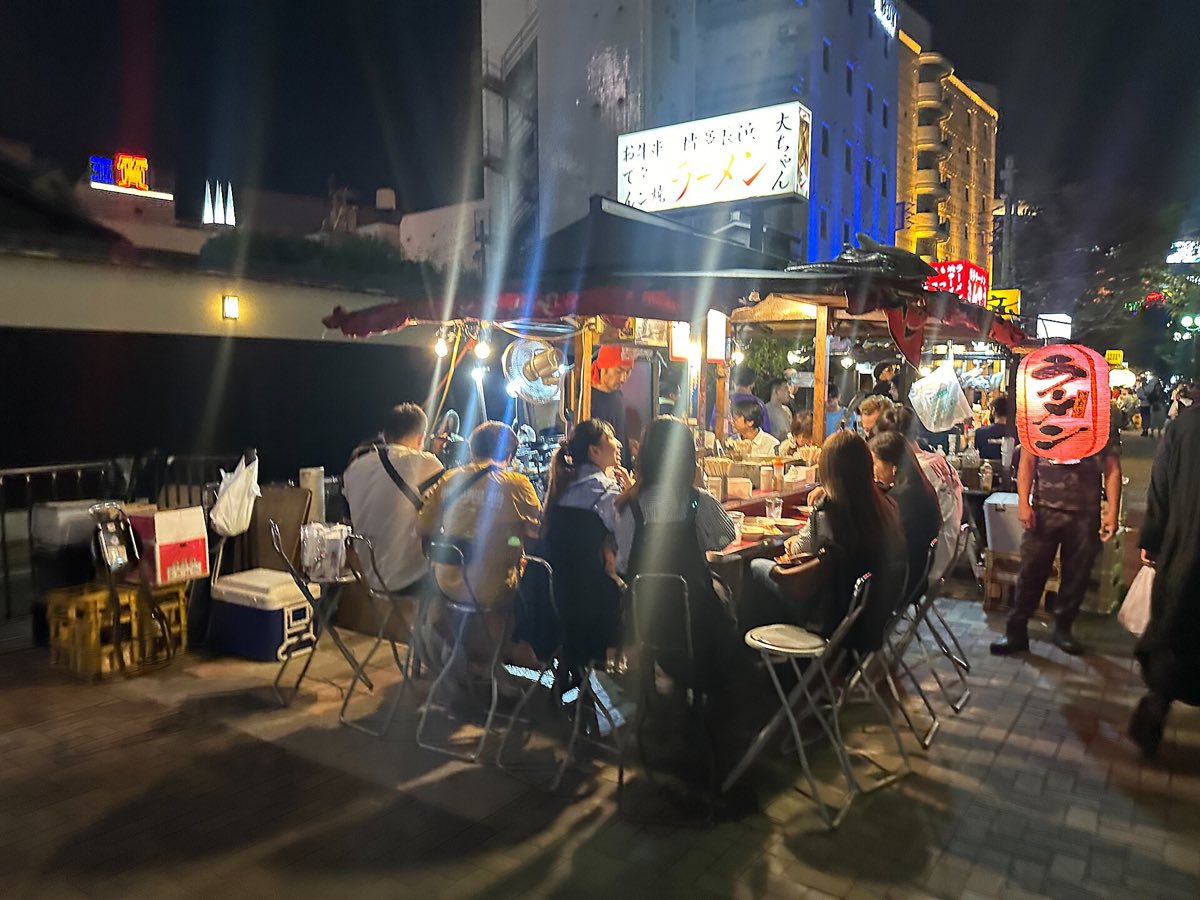
The stallsHonest yatai numbers: the stalls average 3.5/5 across ~757 reviews, and Nishinippon Shimbun — the local paper — ran an investigation headlined 'Are there rip-off yatai?', concluding the tourist-facing Nakasu riverside row is where the price complaints live. Official average spend is ¥1,923 (~$13). The fix is simple: favour the Tenjin and Nagahama stalls over the Nakasu postcard row, ask prices before ordering, carry cash, expect a one-drink minimum, and don't camp the seat — it's a counter, not a restaurant.
The full playbook — which rows, the five rules, what a fair bill looks like — is on the yatai guide. If you'd rather have a local handle the seats, the cash and the handwritten bills, the tour comparison (same crawl, $70 to $255 — really) is on yatai tours, compared.
Stars, and the absence of stars
Fine dining, without the mythThere is no current Michelin guide for Fukuoka — the most recent edition covering the city is from 2019, and nothing here holds a current star. Anyone selling you a 'Michelin-starred Fukuoka' experience is trading on a guide that's seven years stale.
What's actually current: Goh — chef Takeshi Fukuyama's 14-seat communal-table restaurant in Sumiyoshi — sits at #60 in Asia's 50 Best Restaurants 2026 (it is not a top-50 restaurant, whatever older write-ups say), with a tasting menu around ¥18,300 (~$122). That price-to-prestige ratio is the best luxury booking in the city; 14 seats means booking months out. The 2019 Michelin edition's top tier was overwhelmingly Japanese — sushi, kaiseki, fugu — so in Fukuoka you spend big on fish, not on French. Mid-tier omakase with Genkai Sea fish runs ¥8,000–12,000 (~$53–80): a tier below half what Tokyo charges.
Fukuoka produced the 2014 World Barista Champion and the 2013 World Coffee Roasting Champion — a city marketed on pork broth quietly out-brews most of Japan. Where to drink it, from kissaten to third-wave: the coffee page.
Coffee in FukuokaFukuoka food, answered
FAQPage schema pairedWhat food is Fukuoka famous for?
Tonkotsu ramen above all — this is its birthplace region — then the yatai food stalls, motsunabe and mizutaki hotpots, mentaiko (spicy cod roe, invented here in 1949), torikawa chicken-skin skewers, goma saba raw mackerel, and Japan's highest per-capita concentration of yakitori shops. Ramen aside, the through-line is that almost all of it is cheap: ¥3,000–5,000 (~$20–33) covers a serious food evening.
Is the food expensive?
No — it's the opposite problem: deciding what to skip. The famous local ramen shops cluster at ¥999 or under, a station bowl of kashiwa udon is ¥390 (~$2.60), and the official average yatai spend is ¥1,923 (~$13). The ceiling exists (¥30,800 three-star sushi) but the city's genius is the ¥700–5,000 band.
Do I need reservations?
Only for hotpot and high-end sushi. Motsunabe and mizutaki houses want bookings and usually a two-person minimum; top sushi wants weeks to months. Ramen, udon, yakitori, torikawa, gyoza and yatai are walk-in-and-queue — and the queue at 7pm is itself useful information.
What about vegetarians?
Genuinely hard — the signature dishes are pork broth, offal, chicken and fish roe, and standard dashi is bonito — but no longer impossible: the city's own guide lists dedicated vegan ramen shops (BUGORO All VEGAN, Vegan Ramen YADOKARI) and a vegan course restaurant near Hakata Station (kiyu). The key phrase to learn: dashi (kelp-and-bonito stock) hides in almost everything, so ask about it, not just about meat — how to say that so a kitchen can act on it.
Is goma saba safe to eat raw?
This is the rare raw-fish question with a real answer: mackerel is normally cooked because of Anisakis parasites, but the species dominant off Kyushu's Sea of Japan coast migrates into the flesh at a rate roughly 100 times lower than Pacific mackerel. That, plus same-day landing at Nagahama, is why the dish exists here and almost nowhere else. Reduced risk isn't zero risk — pregnant and immunocompromised diners should pass.
What's the food souvenir to bring home?
Menbei — mentaiko rice crackers — if you're flying far: shelf-stable and customs-safe. Fresh mentaiko itself travels 6–8 hours on gel packs (¥1,200–1,500/100g at Fukuya, from ¥800 at Yamaya), but Australia and New Zealand prohibit fish products entirely. Hakata Torimon butter-and-bean cakes (¥1,200–2,500 a box) are the default gift for a reason.
Where should I stay to eat well?
Within walking distance of the stalls: Hakata, Tenjin, Nakasu or Haruyoshi. The subway stops around midnight and the yatai run to 2am, so sleeping near your dinner beats any hotel perk — the full logic is on where to stay and Hakata or Tenjin.
One food day only — what's the plan?
Morning: Yanagibashi market graze, then the Jotenji udon stone on the temple walk. Lunch: the ¥690 Shiromaru at Ippudo's original, or Hakata Issou if you'll queue for the better bowl. Afternoon coffee in Daimyo. Night: two yatai in Tenjin, torikawa in Haruyoshi if you're still standing. Full runbook: 1 day in Fukuoka.
Related tickets, tours and stays
More ways to bookDeep links to specific products for the places on this page. Prices and availability are shown by each provider.
Continue planning
Keep decidingEat it with a local
Fukuoka food tours & tastings — guided street-food crawls and cooking classes with vetted operators, most with free cancellation.