Fukuoka is worth it —
for what it actually is.
Yes — Fukuoka is worth visiting if you travel for food, a relaxed city and day trips, and it's the natural base for Kyushu. Two nights covers the city; four to six makes it a base for Nagasaki, Beppu and Dazaifu. It has no marquee monument: you come to eat tonkotsu ramen at its source, sit at a yatai counter after dark, walk a temple circuit whose admissions total ¥650 (~$4.35), and land five subway minutes and ¥260 (~$1.75) from Hakata Station. Skip it only if your Japan trip is ten days or less and monuments are the point — that slot belongs to Kyoto.
The honest problem: there's no headline sight
The honest problemMost guides oversell Fukuoka's sights. Its own visitors don't — and knowing that up front is the most useful planning tool you'll get.
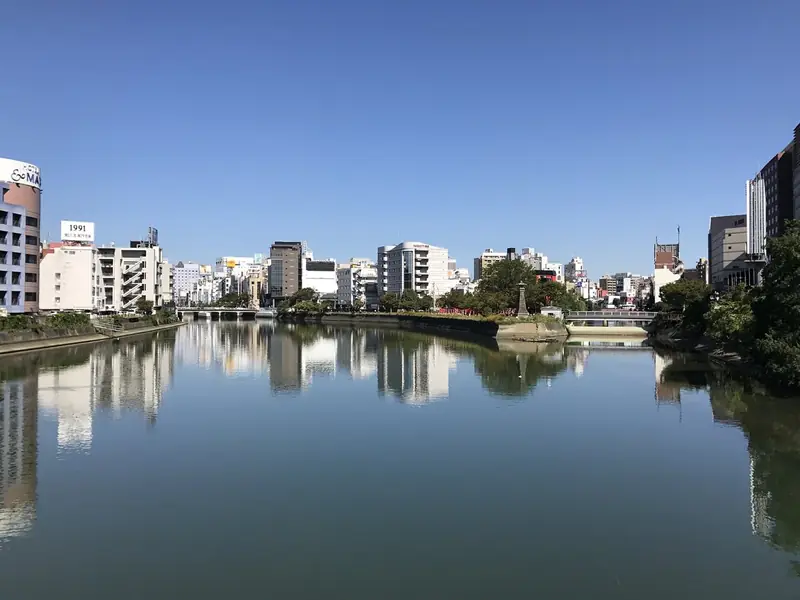
Fukuoka has no marquee monument — no surviving castle keep, no World Heritage temple in the city, no single ticket everyone queues for. Its best-loved sights are a lakeside park, a shrine and the food floors of its main station. That is not a failure — it's the brief. You come to Fukuoka to eat at the source (Hakata tonkotsu ramen, motsunabe, yatai counters after dark), to feel a young, walkable city, and to use the best-connected base in Kyushu. Plan it as a food-and-base city and it over-delivers; hunt monuments and you'll be gone by noon.
Look closer and the pattern holds all the way down. Fukuoka Tower is a view tower, not Tokyo's. The castle is ruins-only — walls, gates and one rebuilt turret. The best-known shopping sight, Canal City, is a mall with a fountain show. And the yatai, the thing Fukuoka is genuinely famous for, disappoint mainly the people who default to the busiest, most photographed row and get sticker shock.
Here's why that's your advantage: there is no ¥3,000 blockbuster ticket in this city, and nothing to queue for. The sights are cheap and 30–60 minutes each — a ¥100 (~$0.65) garden, a ¥200 (~$1.35) museum, a free castle ruin, a ¥50 (~$0.35) giant Buddha at Tochoji. You can do eight of them in a day for under ¥1,500 (~$10) and still be at a yatai counter by dinner.
Fukuoka, quantified
The numbersFour figures that explain the whole city — checked October 2026.
Rather book it?Yatai night tour with a local guide on GetYourGuide ↗
What Fukuoka is actually for
The reframeFood, first and always. Tonkotsu ramen is the city's own style and is cheapest and best-defended at the source; Fukuoka is regularly cited as Japan's densest yakitori city per head; winter belongs to motsunabe and mizutaki hotpots; mentaiko is an entire local economy. And the yatai — open-air counters that set up along the streets after dark — survive as a licensed civic institution on a scale no other Japanese city keeps. Start with the food guide and the yatai playbook.
Second, the base. Fukuoka is the front door to Kyushu: about three in four of the island's foreign arrivals land here, Dazaifu is ~25 minutes on the Nishitetsu line from Tenjin, Yanagawa ~50, and fast trains put Kumamoto and Nagasaki inside two hours. Most of the popular 'Fukuoka' tours physically leave the city — the market agrees with the travellers. See day trips, ranked and the pass arithmetic.
Fukuoka's crowds don't follow Japan's national pattern: about half of all foreign arrivals into Kyushu are South Korean (50.5% in April 2026), with Taiwan next at about 18%, and roughly three in four of Kyushu's foreign arrivals come in through Fukuoka's airport and port. This is Asia's short-break city, not a Western tour-bus stop. Practical consequence: weekends and Korean holidays are the crush; Western-peak months matter less than you'd think. The trend is still running: in April 2026, Korean arrivals into Kyushu were up 14% on a year earlier and Taiwanese up 31%, per the Kyushu District Transport Bureau. Asia already votes with its weekends; Western itineraries are the ones still skipping it.
Is Fukuoka for you?
Who it suitsCome, skip, or restructure — by trip shape
The decision| Your situation | Verdict | The move |
|---|---|---|
| First Japan trip, 14 days, monuments matter | SKIP | Spend the slot on the Golden Route |
| Repeat visitor, done Tokyo–Kyoto–Osaka | WORTH IT | 4–6 nights as a Kyushu base |
| You care more about food than temples | WORTH IT | This is the city — plan around dinner |
| Arriving or leaving via Korea, Taiwan or China | WORTH IT | FUK beats Narita as your gateway |
| Late March, chasing sakura north | WORTH IT | Start here (~29 Mar peak), ride the front to Tokyo |
| One night between shinkansen legs | DEPENDS | Temple circuit + one yatai — doable, tight |
The 2026 Kumamoto earthquake changed none of this: Fukuoka city and every northern day trip run normally. Southbound status, dated and sourced: southern Kyushu access.
Is Fukuoka worth it, answered
Questions people askIs Fukuoka worth visiting?
Yes — as a food, atmosphere and base city. It has no marquee monument (its best-loved sight is a lakeside park, Ohori), but it has some of Japan's best casual eating per yen, a ¥650 (~$4.35) temple circuit, and all of Kyushu off one station. Plan it around dinner and day trips, not sightseeing checklists.
Is Fukuoka worth it if I've already done Tokyo and Osaka?
That's exactly when it's most worth it. You can still walk up to a tonkotsu counter at 8pm on a Saturday and get a stool — the crowd relief is the point. Travel media now pitches Kyushu as the repeat-visitor route for precisely this reason, with Fukuoka as the base.
What is Fukuoka known for?
Tonkotsu (Hakata) ramen at its source, the yatai open-air food stalls, motsunabe and mizutaki hotpots, mentaiko, the SoftBank Hawks, and November's Kyushu Basho sumo tournament. Historically: Japan's first Zen temple (Shofukuji, 1195) and the Mongol-invasion 'kamikaze' coast.
Does Fukuoka have anything to see besides food?
A day's worth of genuinely good, cheap sights: Tochoji's 10.8 m Buddha (¥50/~$0.35), Kushida Shrine, Ohori Park, the castle ruins in sakura season, the gold seal at the City Museum (¥200/~$1.35), and teamLab Forest — which, despite the rumour, never closed. What it lacks is a single blockbuster.
Is 2 days enough for Fukuoka?
For the city itself, yes — two days covers the temple circuit, Ohori Park, Fukuoka Tower or a Hawks game, and two yatai evenings. Add a day per day trip: Dazaifu is a half day, Nagasaki and Beppu are full ones. The full framing: how many nights.
Is Fukuoka cheap compared to Tokyo?
Usually, yes: on ordinary weeknights midrange rooms tend to run noticeably below Tokyo's — check live rates for your dates, because event weekends (sumo, concerts, Yamakasa) sell the city out and spike prices. Food is the clearer win: a serious bowl of ramen is around ¥1,000 (~$6.65), and a 2023 Fukuoka City study put average spend per yatai visit at ¥1,923 (~$13).
Was Fukuoka affected by the July 2026 earthquake?
No. The quake hit Kumamoto Prefecture, well to the south — Fukuoka city and the northern day trips (Dazaifu, Yanagawa, Itoshima, Nagasaki) were not the disrupted zone. Even the Kyushu Shinkansen through Kumamoto reopened end to end on 18 September 2026. The dated detail lives at southern Kyushu access.