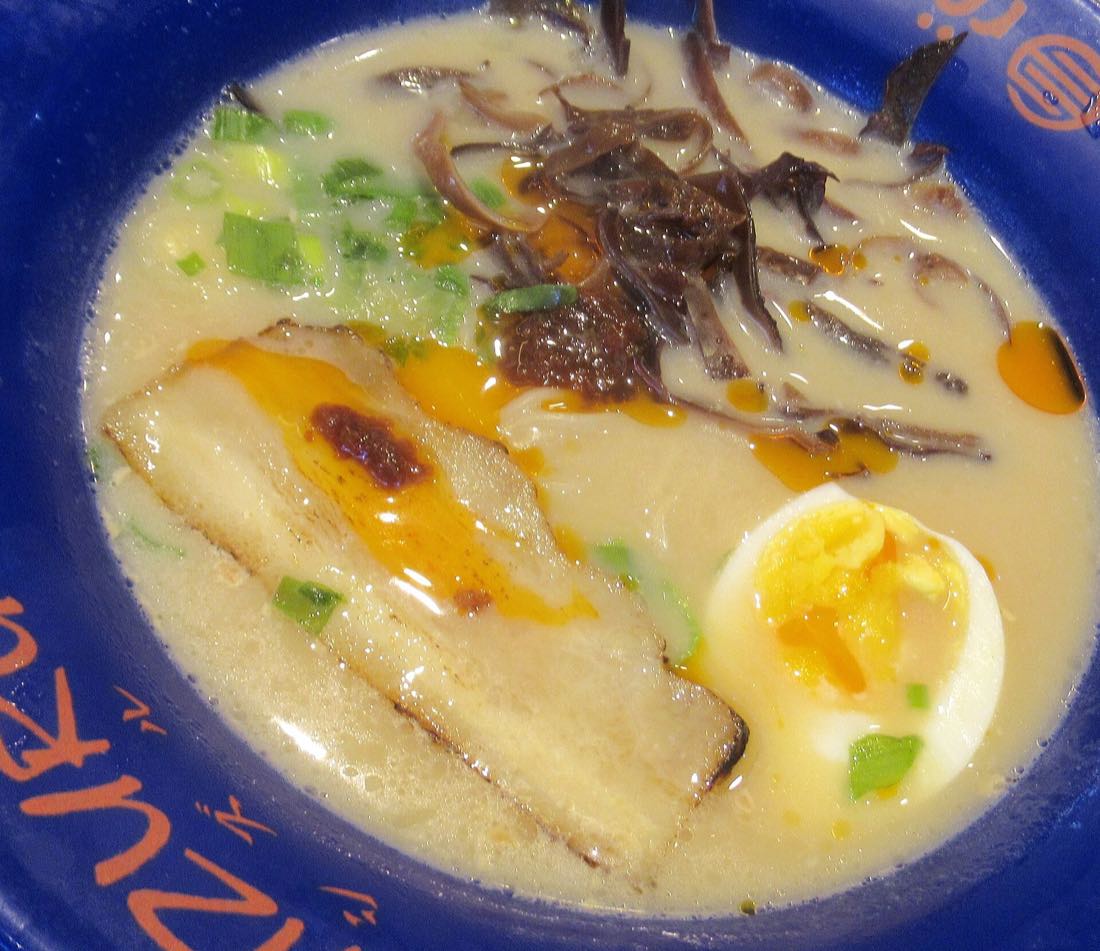
Tonkotsu at the source —
for ¥690.
The shops locals rate almost all charge under ¥999 and almost none are in your guidebook. The originals, the ¥999 cult bowls, the 4am market shop and the reopened Ramen Stadium — sorted.
Eat one bowl at an original: Ippudo's 1985 first shop in Daimyo serves the Shiromaru Classic at ¥690 (~$4.60), and Shin Shin in Tenjin (11:00–03:00, closed Wednesdays) is the best single call for a first-timer. If you'll queue for the foodie's bowl, Hakata Issou's 'tonkotsu cappuccino' is ¥999, seven minutes from Hakata Station. Order kaedama (a ¥100–200 noodle refill) when you're a third from the bottom. Ramen Stadium at Canal City — fully reopened 17 April 2026 with mini-size bowls — is the right answer for families and rainy nights, not for the best Hakata bowl.
What Hakata tonkotsu actually is — and how to order it
The stylePork bones boiled hard for many hours — some shops run 18-to-24-hour simmers, one boils pig heads for two days — into an opaque, milky, emulsified broth.
The noodles are the tell: thin, straight and low-hydration, cooked in seconds and soft within minutes — which is exactly why kaedama exists. You order a refill of fresh noodles (¥100–200, ~$0.65–1.30) into your remaining broth rather than a bigger first serving. Do it when you're about a third from the bottom, and keep some broth back.
Firmness is ordered out loud, hardest to softest: konaotoshi (barely blanched) → harigane (wire-hard) → barikata (very hard) → katame (firm) → futsū (normal) → yawa (soft). Locals mostly live at katame. Say it when you order; nobody will blink at a foreigner asking for barikata.
The price is the quiet miracle: the genuine local rate is ¥700–1,000 (~$4.70–6.70), Tabelog's top-rated Fukuoka shops cluster at '¥999 or under', and a ¥290 (~$1.90) bowl exists at Hakataya in Kawabata — reportedly among the cheapest in Japan. The classic local order is ramen + gyoza + beer for under ¥2,000 (~$13).
Ichiran's flagship, without the lazy take
The Ichiran questionThe internet's stock line — 'skip Ichiran, it's a chain with queues' — doesn't survive contact with locals. A five-year Fukuoka resident in the sentiment record calls the Nakasu flagship 'the king of Hakata ramen', and the shop's claim to history is real: this is the birthplace of the solo flavour-concentration booth, it's the original store, and it runs 24 hours, 365 days, one minute from Nakasu-Kawabata Station. Budget ¥1,000–2,000 (~$6.70–13.30).
The honest verdict is DEPENDS, on what you're buying. Ichiran doesn't appear in Tabelog's locals-favourite rankings, and the ¥999 cult shops beat it on broth — but eating in the room where the booth was invented, via a multilingual paper order form with zero social friction, at 2am when everything else is shut, is a legitimate purchase. Go for the architecture of the experience and the hours; go elsewhere for the city's best bowl.
Which bowl, decided
The shortlistEvery shop verified against local rankings, August 2026. Tabelog scores above 3.5 are genuinely hard-won.
| Shop | The bowl | Price | Verdict |
|---|---|---|---|
| Shin Shin, Tenjin honten · 11:00–03:00, closed Wed | Gentler pork-and-chicken broth, great gyoza, English menus in the queue | ¥1,500–2,000 all-in | WORTH IT |
| Ippudo, Daimyo honten · the 1985 original | Shiromaru Classic — the 1985 recipe at the first shop of the chain that took tonkotsu global | ¥690 (~$4.60) | WORTH IT |
| Hakata Issou, near Hakata Stn · Tabelog 3.71 | The 'tonkotsu cappuccino' — foam-capped broth from 2–3× the usual bones | ¥999 (~$6.65) | WORTH IT |
| Ganso Nagahamaya, Nagahama · opens 04:00 | The unadorned Nagahama origin bowl, serving the fish market since forever | under ¥999 | WORTH IT |
| Ichiran souhonten, Nakasu · 24 h | The original booth system; the frictionless bowl | ¥1,000–2,000 | DEPENDS |
| Ramen Stadium, Canal City 5F | 8 shops, national styles, mini bowls for sampling · reopened 17 Apr 2026 | ~¥700–1,100 per bowl | DEPENDS |
The deeper cut: locals' top-rated shops cluster in Yakuin, Sawara-ku and Maidashi — residential zones, not tourist ones. Hatchan (Yakuin, since 1968, open to 02:00), Ganso Akanoren Setchan (est. 1946, the oldest) and Genki Ippai (no sign — look for the small blue bucket) all sit at Tabelog 3.67–3.74 and under ¥1,000. Most close one weekday; check before crossing town.
Ramen Stadium reopened — and the old advice died with it
The 2026 factCanal City's Ramen Stadium fully reopened on 17 April 2026 after a renovation: 8 shops, storefronts styled as ramen bowls, and — the part that changes the verdict — mini-size bowls alongside regular portions, so you can genuinely compare a Sapporo miso, an Akita chicken paitan and a Hakata tonkotsu in one sitting. Hours 11:00–23:00 (last order 22:30). The stale advice said 'tourist food court, skip it'; the honest 2026 version is: it's the only place in the city to taste regional Japan side by side, it's the single best ramen answer for families (air-conditioned, seats, toilets, no queue anxiety), and it's the correct rainy-night substitute when the yatai don't open. Skip it only if your mission is the best Hakata bowl specifically — those are all outside this building.
Nagahama deserves its own line: the thin-noodle, fast-kaedama style was born feeding fish-market workers, and Ganso Nagahamaya still opens at 04:00. Dawn ramen by the market, then coffee — see the coffee page — is the best jet-lag itinerary in the city.
Eat it with someone who can explain it
Guided, if you want depthYou don't need a tour to eat ramen. Book one if you want the back story — the broth science, the kaedama culture, the shops you'd never find — narrated between bowls.
Fukuoka ramen, answered
FAQPage schema pairedWhere's the best Hakata ramen — Ichiran or somewhere else?
For the best bowl: Hakata Issou (¥999, Tabelog 3.71, 7 minutes from Hakata Station) or the Yakuin cult shops. For the best first-timer experience: Shin Shin in Tenjin. For history at a giveaway price: Ippudo's ¥690 original in Daimyo. Ichiran's flagship is a legitimate visit for the booth-invention story and the 24-hour clock — locals defend it more than the internet does — but it's not where the city's best broth lives.
Is the Ichiran flagship worth queueing for?
At meal times, only if the story matters to you; the food is identical to every other Ichiran on earth by design. The smarter move is going at an off-hour — it never closes, and 15:00 or after midnight usually walks straight in. That 24/7 reliability is its real superpower.
What is kaedama and how do I order it?
A fresh-noodle refill into your remaining broth, ¥100–200. Say 'kaedama onegai shimasu' when you're about a third from the bottom — the thin Hakata noodles go soft fast, so a refill beats a big first portion. Keep enough broth back to receive it.
How much should a bowl cost?
¥700–1,000 (~$4.70–6.70) at local shops — the top-rated places in the city almost all charge ¥999 or less. Tourist-facing famous names run ¥1,000–2,000. If you're paying more than ¥2,000 for a standard bowl in Fukuoka, you're paying for the room, not the ramen.
Is Ramen Stadium worth it now?
Since the April 2026 reopening, yes for the right person: mini bowls let you sample 2–3 regional styles in one sitting, and it's indoors with seats and toilets — the family and rainy-day answer. Purists chasing the definitive Hakata bowl should still head for Issou or the Yakuin shops instead.
What's Nagahama ramen?
The leaner, thinner-noodle sibling style born at the stalls feeding Nagahama fish-market workers — fast noodles, fast kaedama, no frills. Ganso Nagahamaya (opens 04:00) is the reference shop, and the Nagahama yatai cluster keeps the style alive at night. It's also the quietest of the three stall rows — see the yatai guide.
Can vegetarians eat ramen in Fukuoka?
Not tonkotsu — the broth is pork by definition, and 'no meat toppings' doesn't change that. But the city now has dedicated plant-based shops: BUGORO All VEGAN and Vegan Ramen YADOKARI both build convincing vegan bowls. Ask for them by name; a regular shop cannot de-pork its broth.
Continue planning
Keep decidingEat it with a local
Fukuoka food tours & tastings — guided street-food crawls and cooking classes with vetted operators, most with free cancellation.